
Controller Technology Museum

Exhibit Two · Haptics

How games crossed the screen and entered our hands

From a spinning weight to a magnetically suspended physical voice.

02

Before controllers could move, games stopped at the screen. You could see a collision and hear an explosion, but your hands remained outside the event.

The first rumble was blunt and astonishing. Since then, engineers have shaped its timing, texture and location.

Haptics turn game events into motion the player can feel.

Four milestones, then what’s coming

1997Nintendo 64 Rumble Pak1997Sony DualShock2013Xbox One Controller2017Nintendo Switch Joy-ConWhat’s comingGenki Manta

Milestone 1

The controller announces an event.

Museum object 01Nintendo 64 Rumble PakSingle ERM motorMainstream console-rumble landmark

What players noticed

An impact could cross the screen and arrive in the player’s hands.

The mechanism

A motor spins a weight that is deliberately off balance. The wobble is the rumble, which is why it takes a moment to get going.

A small electric motor spins an off-center weight. Because the mass is unbalanced, the rotating force shakes the controller. Faster rotation changes the character of the vibration.

What remained

A spinning mass takes time to accelerate and stop. It is expressive in intensity, but imprecise in timing and texture.
Milestone 2

Rumble gains two voices.

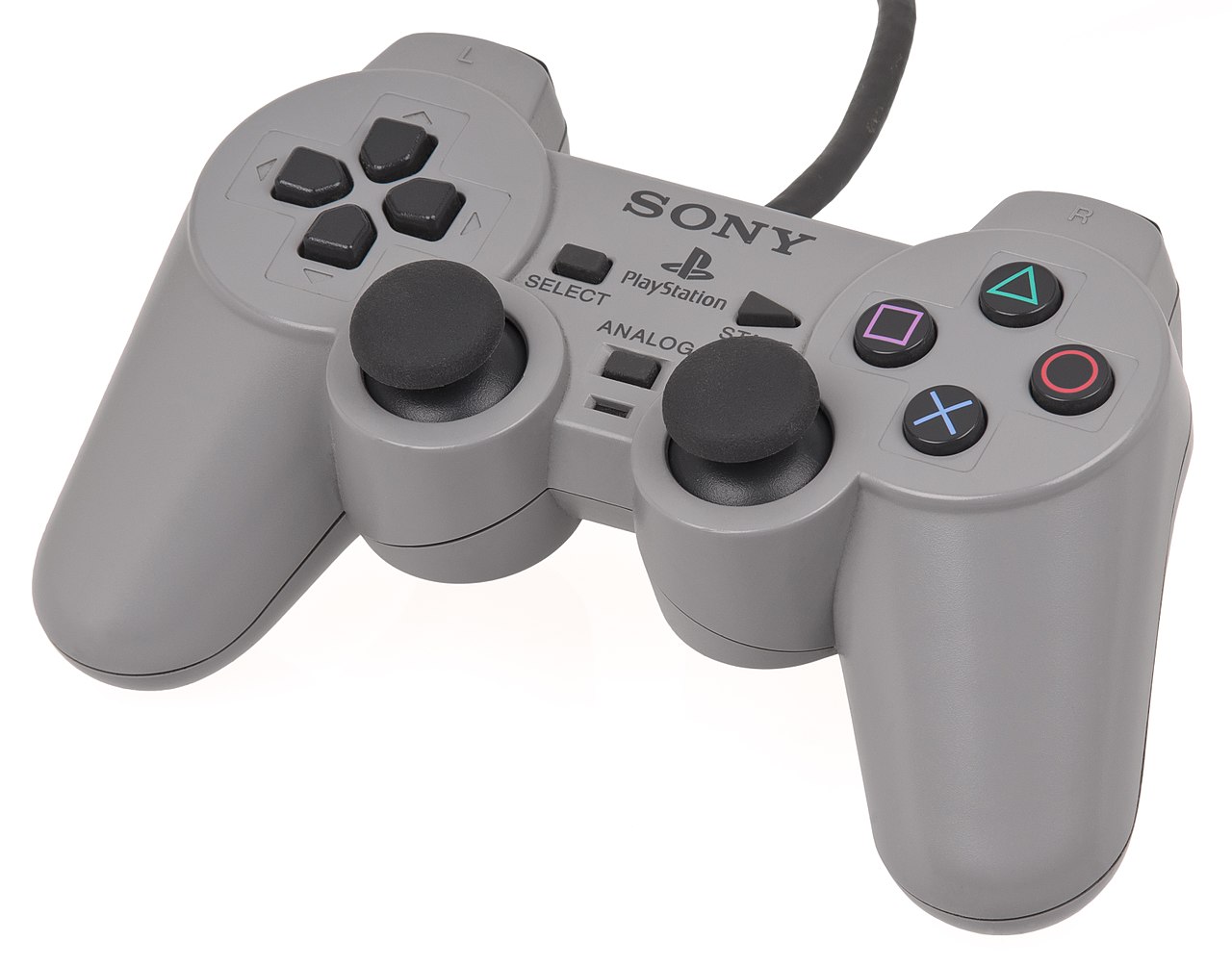
Museum object 02Sony DualShockDual integrated ERMIntegrated dual-motor landmark

What players noticed

Vibration no longer felt like one accessory bolted onto the controller. It became part of the standard object.

The mechanism

Two of those motors, one in each grip, with different sized weights. A heavy rumble on one side, a lighter buzz on the other.

Two motors with different rotating masses live in the grips. The larger mass provides heavier motion; the smaller can feel lighter and quicker. Software can blend them.

What remained

Both voices still came from weights that had to spin up and coast down.

Milestone 3

Feedback becomes local.

Museum object 03Xbox One ControllerImpulse TriggersLocalized trigger-feedback landmark

What players noticed

Feedback moved into the controls themselves, giving the event a specific location under the fingers.

The mechanism

Two more motors move up under the trigger fingers, so a game can buzz the finger pulling the trigger instead of both hands at once.

Four ERM motors divide the work: two in the grips and one behind each trigger. A game can energize the finger applying throttle or brake instead of shaking both hands equally.

What remained

More zones improve location, but every actuator still inherits the timing and bandwidth limits of a spinning weight.

Milestone 4

Vibration becomes a signal.

Museum object 04Nintendo Switch Joy-ConHD Rumble · LRAPrecision-haptics landmark

What players noticed

Developers could suggest clicks, taps and textures rather than only broad shaking. DualSense later widened this idea with broadband voice-coil actuators.

The mechanism

The weight slides back and forth on a spring instead of spinning. Nothing has to wind up, so it can stop almost the moment it starts.

A linear resonant actuator moves a mass back and forth instead of rotating it. Driven near its resonant frequency, it starts and stops more cleanly and can reproduce finer patterns.

What remained

Small actuators can start and stop cleanly, although their size, stroke and mounting limit physical excursion.

Exhibit finale · Maglev Haptics

Rumble you can place in one hand or the other.

Every rumble before it came from a motor that needed time to spin up and time to fall quiet.

Museum object 05Genki MantaMaglev Haptics
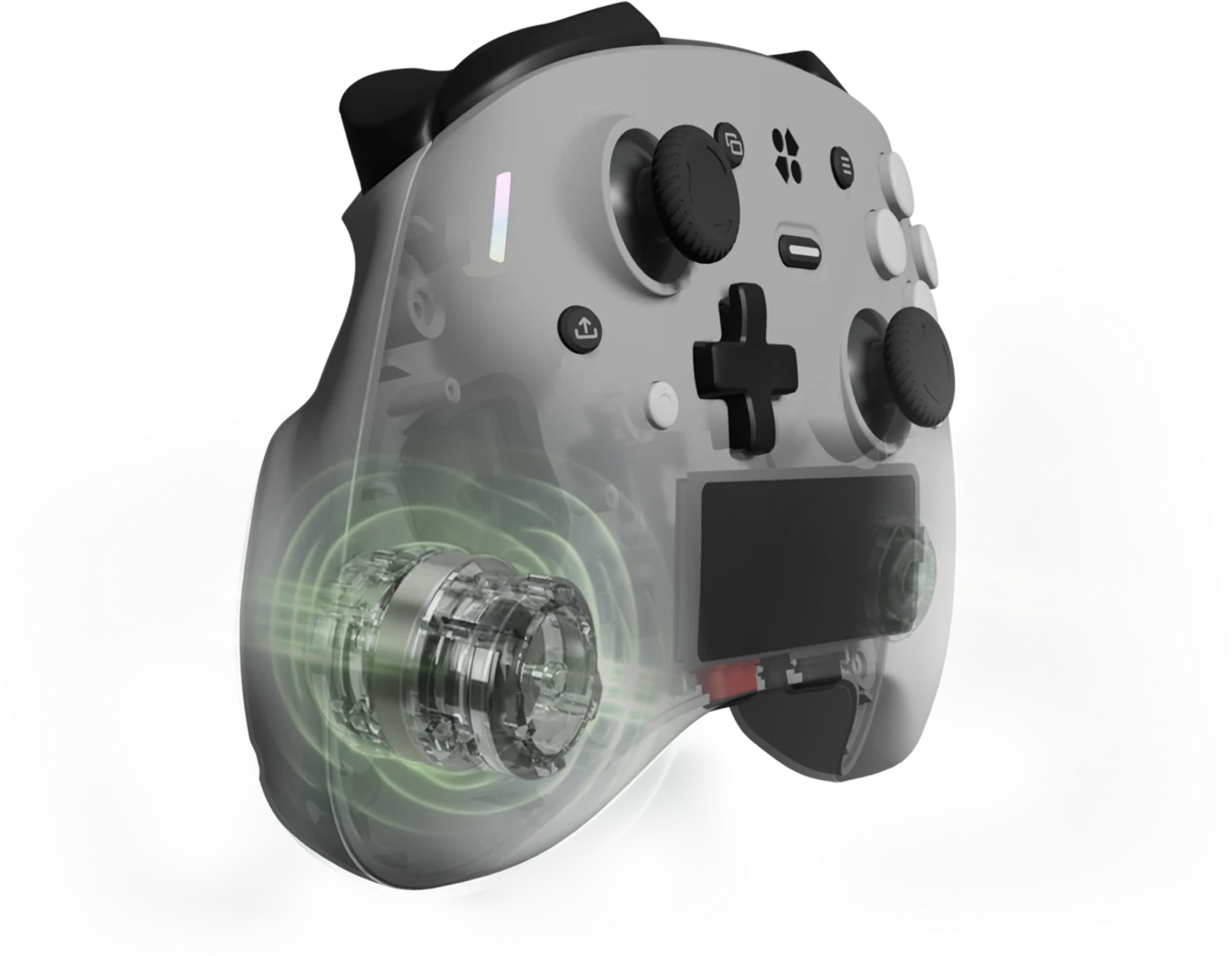
Cutaway view of a Genki Manta grip, showing the Maglev Haptics actuator and its force spreading out into the palm
Genki · 2026 development hardware

What you’ll notice

The goal is a defined hit instead of a buzz that blurs into what follows. The two motors can provide left-right detail, work together across the controller and extend into synchronized audible effects; MantaOS tunes strength, frequency response and force curve.

The mechanism

Like a speaker, but it pushes a weight instead of air. It is turned to fire into your palm rather than down the handle, so the hit arrives where your hand actually is.

Two independent motors

One in each grip, angled so the force lands in your palm instead of down the handle.

Starts and stops on cue

The weight is suspended magnetically rather than on a spring, so a hit lands and ends where it should.

Tunable to the game

MantaOS shapes strength, frequency response and force curve.

Exit through the gift shop

Take Manta home

Everything this exhibit looks ahead to ships in one controller. Manta launches on Kickstarter Thursday, August 20 · 7:00 AM PT · 10:00 AM ET · 3:00 PM London · 10:00 PM Singapore. Follow the project and you’ll be notified the moment it, and the early-bird rewards, go live.

Follow Genki Manta on Kickstarter

Post card

Send this room to someone who would get it.

Curator’s sources

Read past the plaque

  1. Nintendo history: Rumble Pak
  2. Microsoft: Xbox One controller motors
  3. Nintendo Switch technology
  4. PlayStation: DualSense features
  5. TITAN Haptics: Linear Magnetic Ram technology
  6. TITAN Haptics: Echo solid-state LMR
Continue to exhibit 03Program